In short
While slatted covers offer aesthetic floating convenience and solar heating in warm, dry climates, solid safety covers are engineered for the UK's high rainfall and wind. Solid covers form an airtight, 100% sealed barrier that keeps rainwater and debris out while supporting emergency pedestrian loads.
- Solid covers form a 100% airtight seal that prevents rainwater and debris entry.
- Slatted covers float on the surface and do not provide a walkable safety barrier.
- Solid covers prevent water dilution and chemical loss during heavy UK rain.
Handling the British climate: rain, wind, and debris
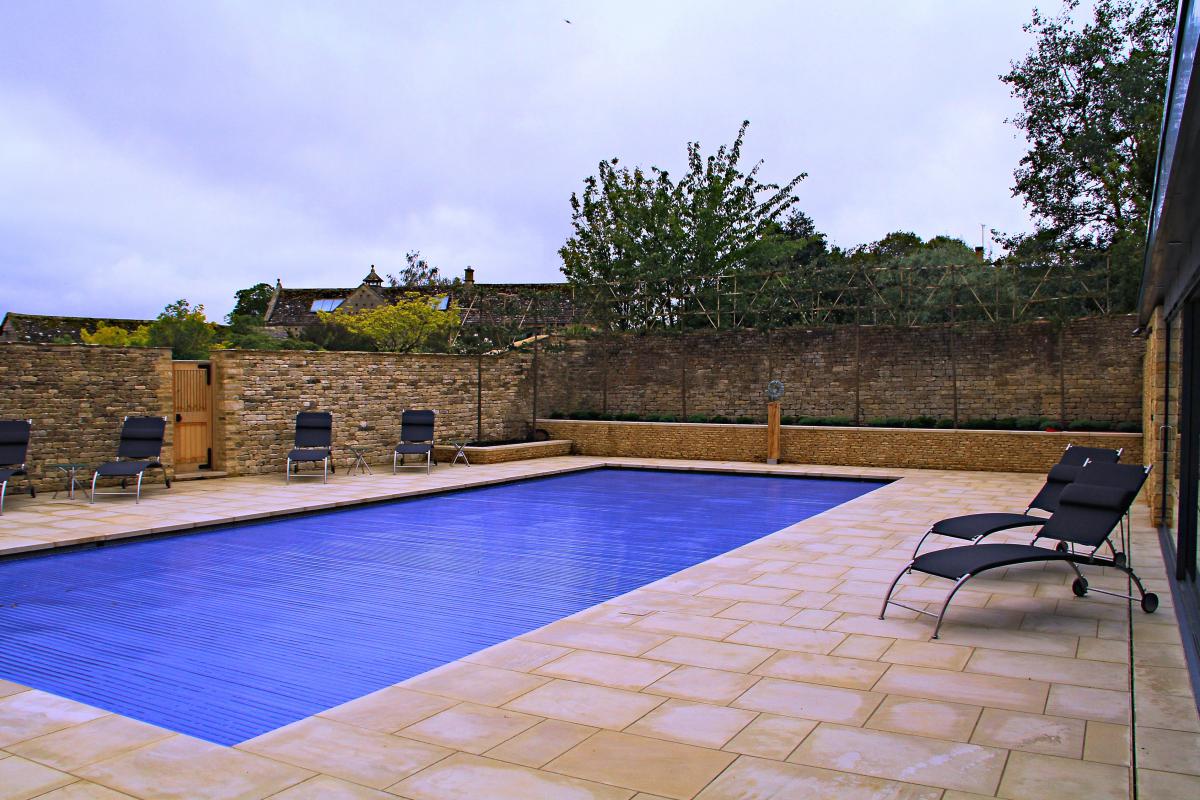
When selecting an automated pool cover in the UK, homeowners typically choose between two main systems: floating slatted covers (polycarbonate or PVC slats) and tensioned solid safety covers (continuous reinforced fabric held in tracks).
In the UK, persistent rainfall, heavy autumn leaf falls, and freezing winter conditions test covers rigorously. Because slatted covers float on the water surface with micro-gaps between hinges, rainwater, organic matter, and fine dirt inevitably seep into the pool, diluting chemicals and fouling filtration systems.
Why solid covers deliver unmatched safety and cleanliness
A solid safety cover forms a continuous, suspended canopy across the pool. Rainwater collects cleanly on top and is automatically removed by a submersible cover pump, meaning zero contaminated water or decaying leaves ever touch the treated pool water.
Furthermore, while slatted covers cannot support the weight of a person (and can separate under point load), a tensioned solid cover is locked into anodised perimeter tracks, creating a solid emergency safety barrier capable of supporting up to 1,500 kg.
Key performance comparison
Total Water Cleanliness: Solid covers isolate the pool from all external elements. Slats allow fine debris and organic runoff through slat joints.
Certified Safety Barrier: Solid safety covers provide a walkable emergency barrier. Slatted covers are not classified as walkable safety systems.
Thermal Efficiency: Solid covers provide an airtight vapor seal that stops 100% of evaporation. Slatted covers reduce evaporation significantly but allow minor vapor escape along track margins.
Next step
Compare solid safety covers and slatted mechanisms for your pool project.
Compare mechanismsQuestions people ask
Can you walk on an automatic slatted cover?
No. Slatted covers float on the water surface and are not walkable safety barriers. For walkable emergency protection, a track-tensioned solid safety cover is required.
What happens to rainwater on a solid pool cover?
Rainwater collects on the tensioned surface and is swiftly evacuated by an automatic sensor-activated cover pump, keeping the pool water underneath completely pristine.
Which cover is better for winter pool closing?
A solid safety cover is vastly superior for winterizing in the UK because it creates a sealed barrier that keeps out sunlight (preventing algae blooms), debris, and freezing rain.