In short
There is no UK law requiring a safety cover on a private swimming pool. The HSE states plainly that there are no specific health and safety laws for swimming pools, and its guidance covers pools used by the public rather than domestic ones. What does apply is occupiers’ liability, which is judged after the fact and weighs heavily where children are foreseeable.
- No statute requires a cover, a fence or any barrier on a private UK pool.
- France requires a safety device on private pools. That is French law, not British.
- Occupiers’ liability still applies, and open water is treated as an allurement to children.
The short answer is no. There is no law in the United Kingdom that requires a private swimming pool to have a safety cover, a fence, or any other barrier. Nobody will inspect your garden and nobody will fine you.
That is not the same as saying nothing applies to you, and the difference is worth ten minutes of reading if there is water in your garden and children anywhere near it.
Where the confusion comes from
Search for pool safety rules and most of what comes back is either French or about leisure centres. Both are misleading if you own a pool at home.
France is the reason half the internet says covers are compulsory. Since 2004, French law has required every private in-ground pool for family or group use to be fitted with an approved safety device, and one of the four permitted devices is a safety cover meeting the NF P90-308 standard. That is genuine law, enforced with real penalties. It is also entirely French. It has no effect in the United Kingdom, and a British installer quoting NF P90-308 at you is describing a product standard, not a legal obligation you are under.
What the HSE actually says
The Health and Safety Executive publishes guidance on swimming pool safety, and its opening line is blunter than most people expect: “There are no specific health and safety laws for swimming pools.”
Two things follow from that. First, even for commercial pools there is no statutory list of required safety equipment. As the HSE puts it, “the law does not state what safety measures an operator must put in place”. What the law requires is a risk assessment, and then whatever that assessment shows to be reasonable.
Second, and more importantly for a homeowner: that guidance is not about you. It applies to pools used by the public, classified as Type 1, 2 or 3 in BS EN 15288-2. A pool in a private garden is none of those. The Health and Safety at Work Act duties that sit behind the guidance apply to workplaces and undertakings, not to your own family in your own garden.
So if you were looking for the rule that tells you what to fit, it does not exist. Which is exactly why the next part matters more than people expect.
The duty that does apply to you
British law does not regulate your pool in advance. It judges you afterwards, through occupiers’ liability.
Under the Occupiers’ Liability Act 1957 you owe a duty of care to lawful visitors: friends, family, the window cleaner, anyone you have invited or permitted onto the property. The duty is to take such care as is reasonable in the circumstances to see that they will be reasonably safe.
Under the Occupiers’ Liability Act 1984 you owe a lesser duty even to trespassers. It arises where you know of a danger, know or have reason to believe somebody may come near it, and it is reasonable to expect you to offer some protection.
Read those two conditions again with a swimming pool in mind. You know the pool is there. You know children live nearby, or visit, or push through hedges. Both limbs are satisfied before anyone has done anything wrong.
Why children change the calculation
The law treats children differently, and openly so. It accepts that a child may be too young to understand trespass, that children are naturally inquisitive, and that it is therefore foreseeable they will get into places they should not be. Open water is the classic example of what lawyers call an allurement: a hazard that attracts precisely the people least able to judge it.
The practical consequence is that “they should not have been there” is a weaker defence with a five year old than with an adult. What matters is whether you took reasonable steps, knowing what you knew.
What reasonable actually looks like
Nobody can tell you a legally required specification, because there isn’t one. But the question a court would ask, and the question an insurer will ask first, is the same: what stops a child reaching the water when nobody is watching?
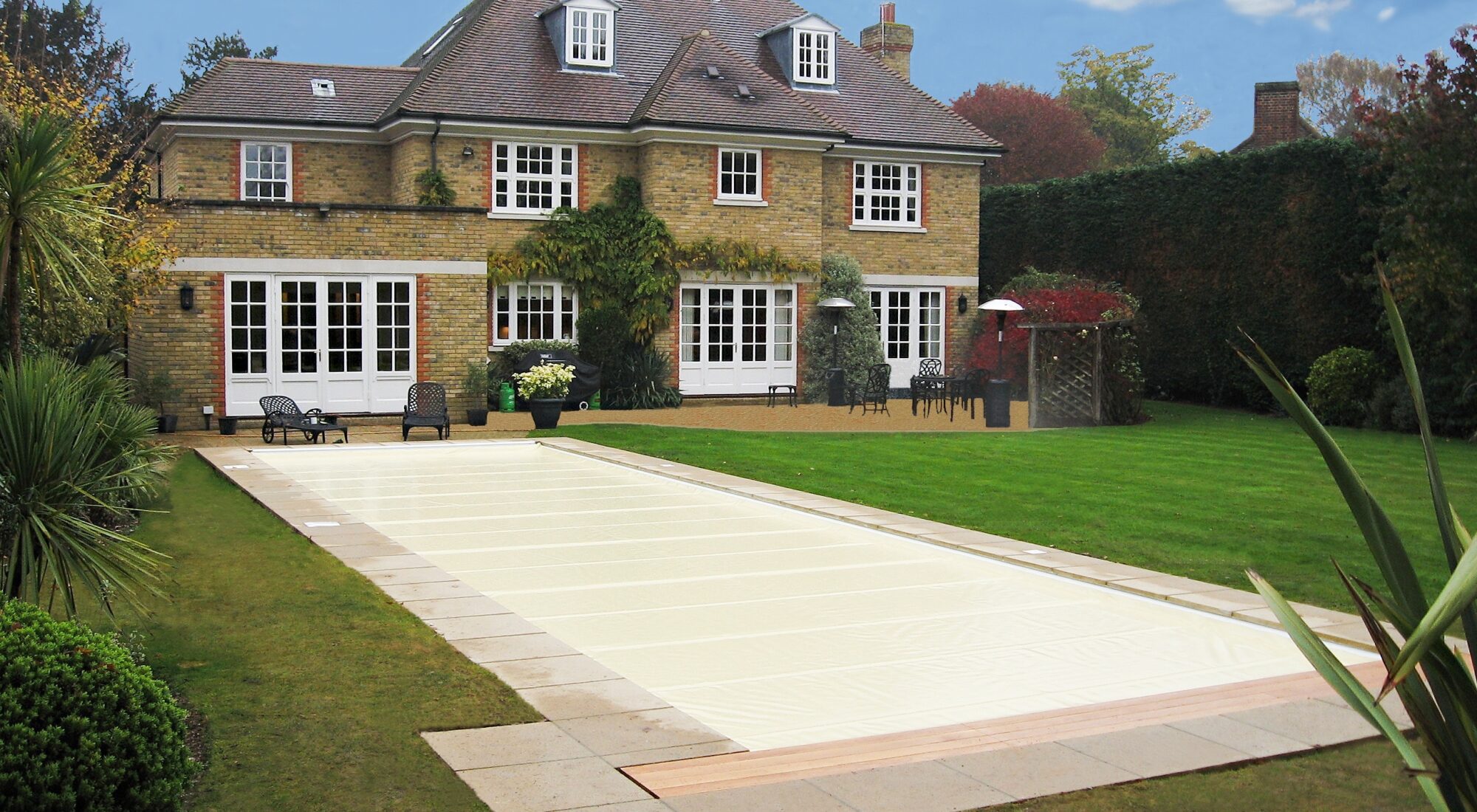
A solid safety cover answers that directly. Closed, it is a barrier over the water surface rather than a warning about it, and one built to carry the weight of a child who walks onto it removes the failure mode that matters. A fence answers a different version of the question, by keeping the child away from the pool rather than off the water. Many pools have both, and there is no rule saying you must choose.
What none of them do is remove the need to watch. A cover reduces risk. It does not remove it, and it does not replace supervision of children around water.
Two questions worth asking before your next renewal
Your insurer is where the absence of a law becomes concrete. Ask them what they expect you to have in place, and ask whether it is written into your policy. Insurers frequently take an interest in what barriers exist around domestic pools, and a policy condition is enforceable in a way that general guidance is not.
This page describes the general position in England and Wales and is not legal advice. If something specific turns on it, whether a policy condition, a boundary dispute or a planning question, ask a solicitor about your own circumstances.
Next step
Tell us about the pool and an engineer will say what a cover would involve on yours.
Questions people ask
Is a pool fence required by law in the UK?
No. Neither a fence nor a cover is required by statute for a private pool in the UK. Both are ways of discharging the duty of care you owe under occupiers’ liability, and many pools have both.
Does NF P90-308 apply to my pool in Britain?
Not as a legal obligation. NF P90-308 is a French product standard for pool safety covers, and French law requires an approved device on private pools there. In the UK it describes how a cover was tested, not something you are required to fit.
Will a cover satisfy my insurer?
Ask them, and get the answer in writing. Insurers often take an interest in what barriers exist around a domestic pool, and a policy condition binds you in a way that general guidance does not.